Tuesday, June 5, 2012

An Extraordinary Journey

This past weekend would have marked the one year anniversary to my arrival in Mali and the start of one amazing, unforgettable journey- a journey that began with 23 wide-eyed, nervous strangers in a D.C hotel and ended (albeit in tears and heartbreak) with a plethora of relationships and lifelong friends all bound to a country, culture and people we have come to love. Here is the breakdown of the experience that taught me that life can take an unexpected turn at any moment, and you shouldn’t take for granted the time that you do have. Life is too short not to follow your dreams and be happy.
On Thursday, March 22nd, I woke up in my mud hut to the BBC World Radio breaking the news of a coup d’état and overthrow of the Malian president and government by a military junta. Unable to access any further information, I continued my day waiting for updates via cell phone. A mere 48 hours after the coup, all volunteers were told to consolidate to our respective regional capitals. We begrudgingly left our villages, confused and angry for the disruption to our projects, plans and lives. We arrived with questions and confusion. The media, Peace Corps, and frankly most of the world had been blind sighted by the sudden events and upheaval. Mali was considered Africa's model democracy. With the democratic presidential elections only a month away, this event seemed untimely and unnecessary.  As our access to information expanded and came flooding in, we found out that in a matter of hours, the government had been overthrown, the constitution suspended, the national television and radio station seized, a nationwide curfew enforced, and all borders closed.
The days of consolidation were spent checking the news constantly and obsessively. Every Peace Corps and U.S Embassy email and text message was evaluated and scrutinized as we attempted to decipher our ominous fate. While we rode the emotional rollercoaster of optimistic highs (returning to site) and dreaded lows (the fear of evacuation) as best we could, there is nothing that can really prepare you for the gut-wrenching news of an impending evacuation. That the peaceful, simple life you were leading will suddenly become a big mess. It is a change that happens so suddenly and with such immediate effects, that you are left numb and in shock. After forty years of uninterrupted service to the people of Mali, Peace Corps was evacuating. And it was not a decision made lightly. We left the country with ECOWAS sanctions going into effect- a result that led to major disruptions to the banking sector, closing of the borders, depleting supplies of gas, limited public transportation, and increases in prices in food and other supplies. It was decided that Peace Corps could not reasonably expect to function and provide at least minimal support to the Volunteers.
For many of our Malian friends and counterparts in our communities, our evacuation was difficult to understand. The fighting, protests, and minimal violence has been, even now, contained almost entirely to the capital, Bamako. Literally nothing has changed in my village. This season’s wedding ceremonies are coming to a close, and as the first of the heavy rains begin to fall and nourish the dry, arid land, preparations for the next farming season are being made.
Exactly one month after the coup d’état, I returned home. It has taken some time for me to recover both physically and emotionally from my time in Mali. I came home exhausted-tired of being frustrated, tired of crying, and tired of saying goodbye. While everyday is a little easier, it is still difficult to accept that while I can return to the comforts of home, my Malian friends and family are stuck to face the harsh repercussions of the coup d’état, repression in north and the food crisis in the Sahel.

Our amazing country director wrote to us saying that he had a strong hunch that a number of us will find work, research, or other projects or activities that will one day soon bring us back to Mali. I can only hope that I am that fortunate, because there is definitely something addictive about Malian culture and hospitality. It is a place that changes you forever. Mali is one of the top twenty poorest countries in the world, but their culture, values and traditions are extremely rich. They withstand extreme hardship with the largest and brightest smile you have ever seen. They take you in as part of their family, change you for the better, and teach you valuable lessons. During our Close-of-Service conference, one of our counselors compared Mali to our first love.  And it is true. It is a great love-a love that I will never forget and always have.

My host sister and her two daughters. Pure happiness. I will miss you.

Tuesday, March 13, 2012

Stuck

I’m sitting on the balcony of the stage house in Bamako, and it’s beautiful outside. I’ve spent the past few days in good company with all of the good food and TV/internet every deprived Peace Corps Volunteer craves. And I have six more days of it! …but the thing is I don’t want it. I miss site.

I have been gone since last Monday. First to my Regional In-Service Training in Kita, then to Bamako to see a dear friend home, and now I have to wait around to get a mole removed. It is most likely nothing serious, but I can never be too careful as melanoma is in my family. I know that being out for health reasons is completely legitimate, and with all the physical and mental stress that comes with this job, my health has to come first. BUT, I can’t help but feel guilty for being away; feel like I am not doing enough, not doing all that I can to help these people and this place that I have come to love.  Site guilt plagues many volunteers, and it is something that, for me at least, is always luring in the background. I will most likely have to deal with these feelings till the end of my two years, feelings of uselessness and inadequacy, like I am letting my village down. Some days these fears cloud my mind completely and are usually compounded when I am away from site. So, today just happens to be one of those days.

Bear with me as I bemoan in hopes that it will ease my mind.

I miss running after Hamadi my 1 ½ year old little brother who has just begun to speak. His first word was my name.

I miss joking and chatting with my grandmother, Nandi, after dinner every night.

I miss Yah, my 12 year old best friend who comes over every evening to help me water my garden after which we get all sticky and messing eating a papaya.

I even miss my elderly neighbor, my togoma (someone who shares the same name as you) Sira who gives me a hard time about everything.

I miss the simplicity of it all: waking up at dawn, going to bed with the setting sun and filling the in-between spending time with some really amazing people in a truly wonderful place.

Saturday, March 10, 2012

Improved Cook Stoves

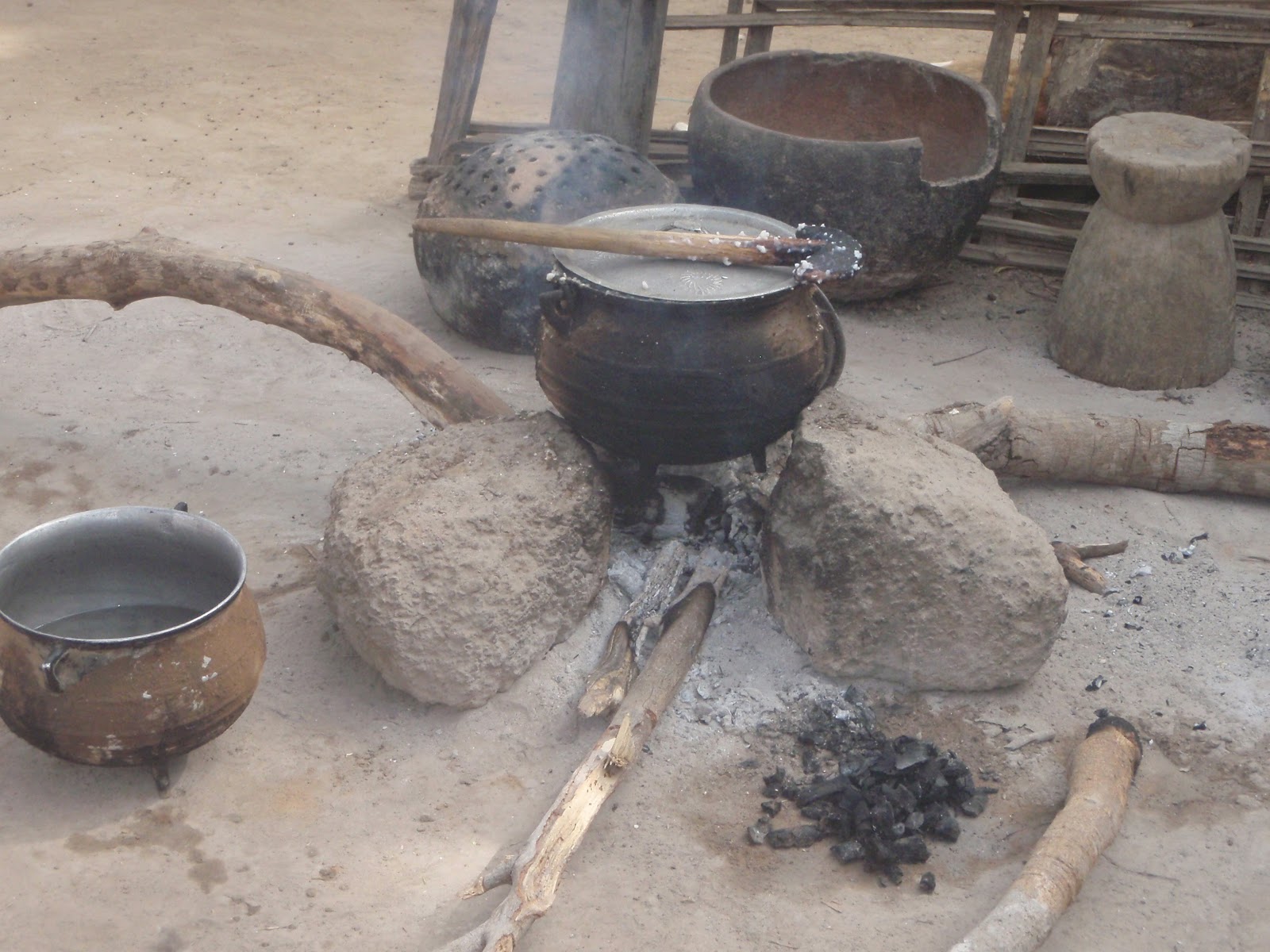
Fuelwood comprises the main source of energy for a vast majority of people in Western Africa. Specifically for the women of my community, one of their main daily tasks- cooking- takes a lot of time, effort and wood. It is the women's job to travel en brusse to chop and collect the firewood. Everyday, I see women carrying bundles of wood stacked on their head and donkey carts full of firewood trekking through thte village. However, the current practice of harvesting and collecting this resource is not only exhausting but also wholly unsustainable and is contributing to deforestation of the local area.


This is the typical Malian three stone cooking method.

To prevail over the Three Stone Fire, the Improved Cooking Stove aims to save cooking time by increasing efficiency and to reduce the volume of smoke emission. To improve on the three stone fire requires an insulated combustion chamber. By forcing the heat to scrape against the sides of the cooking pot will improve the heat transfer and help reduce the amount of firewood needed.


Before and After!

This is my friend Jamie and an finished improved stove


A great variety of modifications can be implemented to improve the effectiveness of a stove; ranging from additives to the mud to the physical proportions of the stove itself. The biggest difficulty I have had is convincing the women to agree to the one door model. They are not pursuaded of the effectiveness and prefer to be able to control the heat of the two pots. Therefore, I have adapted the model to allow for two doors while still preserving and improving the efficiency.


This is an example of the adapted method
The women are really excited about the stoves. I even have a waiting list!

Thursday, February 9, 2012

Pics of the month!

A montage of this past month:


Want to make some lunch?


First you pound the millet


Then you sift it


Cute kids of the month: Hamadi


And Fatoumata


Want to make a house? First you need to make the bricks which are a nice mud/straw mixture...


Make some more mud to stick the bricks together...


Here is the layout/foundation


 And make the roof out of some bamboo pole and straw. So all you really need is some mud, more mud, some bamboo, and maybe a little more mud and voila, you have a house!


The afternoon activity...


Hair Braiding

Wednesday, February 8, 2012

Let's make some soap!

Early December some women in my village expressed interest in making soap. Making soap is something that all the women can and do make by using oil from a nut that grows locally. However, they were most enthusiastic about making the "good stuff": Kabakuruni which they use to wash clothes and also toubabou sahuna (literal translation: white man's soap). But, since their work with the harvest was not finished we decided to address the idea in the new year.
You are probably asking yourself, "Does Taz even know how to make soap?" Honestly, I had only seen it been done once during one of our trainings but other than that all I had were a handful of recipies. It seemed simple enough, so I was willing to commit as you should really jump on any idea/project that your village is genuinely interested in as it increases the likelihood of it being sustainable. If they want it to succeed, they will make it happen...but not without a fair share of bumps in the road. This is Peace Corps after all.
I took the opportunity to address the women again when they were all gathered for another meeting held by a local NGO. The floor ended up being all mine as the guy never showed up which turned out to be foreshadowing for what I was to experience. I found out that the women weren't solely interested in learning how to make the soap; they wanted to start a small business and generate income for themselves. Therefore, taking things slowly, I gave the women the task of assembling their group and choosing a President, Treasurer and venders by our next meeting in one weeks time.
On the date of our meeting, my homologue and I waited for approximately 45 minutes before I resigned myself to the fact that no one was showing up, so I went in search of some answers. The response I received: "We forgot." Every single one of them. When working with illiterate people in a culture that has no sense of or need for time, this is a common result. If it weren't for the daily radio communication, I'm sure that my village would be oblivious to the day and date and would honestly be none the worse for it.
I could very easily have reminded the women the day before, but in the back of my mind I think I wanted to test them. To see how dependable and accountable they could be. Since that was a total fail, I decided to start over-- clean slate, no expectations. Since this was my first "project," I figured that we, the women and I, would be learning along the way.
With the small group that I could rally together that morning, we decided who would head the positions (which were met by many objections and essentially forced upon the women because they all shy away from any responsibility of importance which I think is due to their lack of education), decided that they would contribute the 12 litres of shea oil as they can produce that themselves at zero cost, and finally decided on a date and place . Everything seemed to be in order.
However, when I returned from my trip to Kita where I bought the rest of the ingredients (peanut oil, lye, and honey) we were met with another little bump. The formation was to be in 2 days time; however, the machine to grind the shea nets had not yet arrived. It had gone travelling to the surrounding villages (there is maybe one machine for our 4 village radius) and wasn't due to return in time for our formation. Not a huge bump, so we just pushed the date back.
FINALLY, the morning of the formation arrived, and thankfully, so did the women!! At first they trickled in each bringing their contribution, 1 litre of shea oil per woman. We soon had the 12 litres needed, but they kept coming until we had collected 29 litres of shea oil. Compared with the 8 women that I rallied that first failed meeting, this was a vast improvement and more than I expected. I was pleased that so many women were committing. We began the formation with my homologue and I explaining and instructing the women who would then perform the tasks. Its really quite simple to make soap: mix the ingredients together, stir continuously in one direction till it begins to set, pour in the mold, ABANA. So, where did I go wrong!!?? We were stirring for an hour, two, almost three hours and the mixtures were not hardening. It should have taken less than an hour. As time moved on, I slowly became deflated. I was responsible- it was my first project and it wasn't working. I felt like I had dropped the ball. Its a horrible feeling that hits you right in the gut.
I tried to stay poised and figure out a solution, but it was the women who saved the day. They took charge and figured out the problem. As it turns out, it wasn't completely my fault, but most importantly our work was salvagable. I had bought the 2kg of lye needed; however, it seems that I had been deceived and taken advantage of in the market. I bought the lye for 1000 cfa- 500 cfa per kilo, but talking to the women at the formation, 1 kg should cost 800 cfa. I was ripped off. I paid more and received less because I am white. This happens all too often actually. It is assumed that the white person has money so their prices will be inflated.
It took another day for us to acquire the correct amount of lye, so after releasing all the control to the women (which I should have done from the get-go), we finished 2 days later. Even though there were more than our fair share of bumps in the road, I think that I can call this a success. Even when I was ready to claim defeat, the women continued to praise the soap we were making. Their positivity kept me from breaking down, and in the end they were right. The soap turned out great. So great that the women of the formation bought half of the stock right off the bat! As soon as we set the prices, they went grabbing at it. AND, the rest of the product was sold in a day and a half! SUCCESS!!


First the women melted the shea tulu by the fire


Mixing the oil, lye, and honey for the Toubab Soap
The soap is in the mold!
The women hand-molding the Kabakuruni

Final Product!

With the money made from this first round, the women are going to be able to continue production and even have profit left over. Making soap here is very lucrative! The women are motivated and excited, and so am I!

Friday, December 23, 2011

Images from this past month at site...


One of the men in my host family standing by some recently harvested millet- the main staple of the Malian diet.


After the millet is harvested, the men "gosi" or hit the millet to release the grain from its shell and then the women have to sift it.


A little extra height...


Since I am not a skilled Malian farmer, I am appointed babysitter. These are two of my little boys, both around 1 yr: Jangoba and Hamadi


One afternoon, I conducted an art class with my second graders. They were so excited when I gave each of them a piece of colored construction paper and a selection of crayons to use. They were even more floored when I told them they could take it home!


My class with their masterpieces. (A special thanks to Judy Cooley for sending the supplies)


I started painting a world map in one of the classrooms as part of my attempt to "beautify" the school. I'm hoping that these murals will motivate and entice the kids to stay in school- something I hope they can be proud of.


During my in-service training, we were introduced to a miracle tree that can help combat malnutrition. The Moringa tree is already well known and used throughout Africa but has not caught on in Mali as of yet. Four months after planting, the leaves are ready to be harvested, dried in the shade, and then pounded into a powder to be added on top of your meal. 100 grams of the powder has 7 times the Vitamin C of oranges, 4 times the Vitamin A of carrots, 4 times the Calcium of milk, 3 times the Potassium of bananas, and approximately the same amount of protein as one egg. Since the harvest has been poor this year due to the dismal amount of rain we received, it is especially important that the villagers atleast receive these important nutrients during hunger season. Here, my homologue and some of the villagers are standing with some of the pepinieres that will be transplanted once they have sprouted.


Some of the little girls next door had a blast playing with my dirty soapy water after I was done doing my laundry. When you don't have a lot to play with, anything can be fun!


The chekoroba (literal translation: old man) next door, who is too old to go out to the fields to farm, spends the day weaving baskets out of bamboo.

Tuesday, November 22, 2011

This just about sums it up...

This past week has been a rollercoaster of emotions. My stage and I are currently in the throes of our In-Service Training where we are learning all about project design management, funding, budgeting and other practicum. After our three month lockdown at site, many of us arrived motivated, inspired, and ready to mobilize as we are finally allowed to start executing projects after these two weeks of training. However, as each day passes I feel the weight of the expectations (mine, my village's and Peace Corps') press heavily on my shoulders. We all desperately want to make a difference- a tangible difference- but are lost as to where to even begin. As I continue to try and reconcile with these feelings, I stumbled across a Huffington Post blog article that sums up these woes better than I am able to at this moment:

What The Peace Corps Taught Me About Failure
Volunteer life bursts with cultural faux pas, fruitless projects and second guesses. For two years, I felt like the joke was on me. Even on my best days in Senegal, the sudden scream of "toubab," a taunting word for foreigners, reminded me that my cheerfulness was jinxed, my presence perhaps unwelcome.
In West Africa, I confronted the toubab version of myself, a self previously foreign to me that was lethargic, cynical and at home with failure.
For a long time I hesitated to admit that I felt incompetent as a Peace Corps volunteer. I felt that if I expressed my suspicion that I was inept, it would confirm criticisms that the program itself is irresponsible and presumptuous. I signed up largely because I saw myself as a go-getter and I wanted a challenge. I have a childlike loyalty to getting things right; I lack a cleverness for bullshitting. Yet these traits, from which I had previously derived strength, became the source of my immense heartbreak.
I did extra work in my demonstration garden only to find out later that agriculture agents resented me for it. I had lengthy, optimistic conversations with a village chief about starting a community garden only to discover that I misread his reaction and that he was, in fact, against the whole endeavor.
When a project faltered, I wondered if I should blame the cultural difference or my language skills, my lack of expertise or my accidental impropriety. I never knew for sure.
And yet, seeing my confidence unravel was helpful. Maybe everyone needs a period in their lives when they barely recognize themselves.
The story that Peace Corps volunteers like to tell -- and Americans like to hear -- is one of urgent and awe-inspiring work. Americans like to feel that at least someone is out there fighting all those incomprehensible African problems.
This narrative is too simplistic.
As the Peace Corps celebrates its 50th anniversary, some still find it hard to put a finger on what exactly the program achieves. There are both quantifiable yields, like number of wells dug and trees planted, and unquantifiable gains, like the intimate bonds volunteers make with people all over the world.
One benefit of the program that is never trumpeted (and likely never will be) is that it produces a group of young Americans who understand failure.
Americans, especially the variety who join the Peace Corps, are raised to believe that hard work pays off. We come from a place where the phrase, "We'll meet tomorrow at 5," means, "We'll meet tomorrow at 5" -- where you put a stamp on an envelope and it gets delivered.
"Failure is not an option," according to the locker room poster likely brought to us by the same people who birthed "Impossible is Nothing." Americans are immature when it comes to honestly accepting failure and maybe that's why so many of us lack the emotional depth to make sense of it.
We all have failures, yet we bury them in the folds of our pasts as curious gaps in our résumés and cryptic replies to direct questions. If we are unable to emerge triumphant, our failures eat away at us.
My Senegalese comrades are less brittle. They admit freely that their lives are full of fiascoes, delays and disappointments.
When I asked locals in Pulaar how work was going, I didn't often hear: "Oh, just fine!" Instead, the response was a more honest, "I'm trying, little by little." It seems to me that growing up with unpredictability has better equipped the Senegalese people to persevere in the face of real obstacles.
The same barriers Senegalese people manage to climb over regularly ended some of my projects. When I tried obtaining a grant for a women's farm, the land rights had to first be legally transferred to the women themselves. While the paperwork lingered in a government office, I foolishly kept preparing for the project that would never be, blocking off months in my calendar that I would devote to it. Meanwhile, the women moved on, continuing their own, smaller version of the farm they wanted. They knew not to rest their hopes in government offices and the men who shuffle within them.
I don't mean to give the impression that Peace Corps volunteers don't accomplish anything. We do a lot of the things other aid organizations do, but our version is less grandiose: We hold small-group trainings on childhood nutrition and organic pest control. We help small businesses grow, often through a series of one-on-one interactions. Our hyped-up expectations of success are often quashed--we learn quickly that smaller is better.
I survived two years in the Peace Corps. My proudest accomplishment during my time in Senegal, one that can't be expressed on a résumé, is how much I grew up.
I now know that no occupation, despite my generation's obsession with passion-following, is without compromise or disappointment. And I know that failure, despite its negative connotations, takes practice.
Maya Lau

Friday, November 18, 2011

Update!

A little while ago, I wrote about a one month old infant boy who was struggling to survive after the passing of his twin brother. Little Fouseyni, sick and fragile, seemed to be wasting away in my arms.
However, after a few weeks of consistent bottle-feeding, he began to drink from his mother's breast again. Dooni Dooni, I have noticed that he has been gaining weight and is now looking much healthier! Here is a picture of myself and my little soldier:


Monday, October 24, 2011

So, I am now a first grade teacher?!

After missing the first 2 days of the new school year due to illness (it was only a middle ear infection this time-very painful, but a piece of cake compared to my first bout with being sick in Mali), I arrived at the school reliving the same excitement and nervousness that would enveloppe me as a student each new school year. Yes, I was one of those who loved going to school and would never miss a class.
That day, I held a meeting with the teachers and the CGS, the Malian equivalent of the PTA. With the help of my homologue, we had a very indepth conversation about the difficulties and challenges with education that the school and village faces. We even briefly breached how they would like me to help them-which projects they would like to start. However, as none of that work can commence until December after my In-Service Training, I spent the rest of the week observing each class. It became apparent quite quickly how disfunctional the education system within my village is, and these challenges are something I would come to understand first-hand as by the end of the week, I had become the First Grade teacher.
To have one teacher instructing two grades is overwhelming, especially if it is the first and second grade filled with 5-8 year olds who can't sit still. Madame was so clearly exhausted by midday that I offered my assistance in any way that I could and thus became Madame Sira, Maitresse of the premiere annee. In this new role, I have come to clearly understand and appreciate how hard the teachers work and what they are up against. In the first grade class, I have children crammed in their seats- 4 to a table-bench that is supposed to seat 2. Some benches don't have backs to the seats and one bench doesn't even have the table. As I attempt to instruct the children (in French/Bambara) in the ABC's and introduce the basics to writing, half the class sits idle as they don't have a chalkboard or chalk. While the lack of learning materials poses quite the challenge, the students make up for it in their eagerness and motivation to learn. I always have a sea of hands to choose from when asking for a volunteer and usually have to shout over the cries of "Madame, Madame!".
As each teacher is overwhelmed with the 2 classes, I have noticed that some students fall behind never to catch up because there is no time for individual attention. These students are simply passed on to the next grade where they continue to get overlooked and eventually do not return. It is a vicious cycle. On the weekends, I have begun to give extra lessons to the children in my host family because as 4th and 5th grade students, they struggle to add, subtract, and even write ledgibly.
As this experience progresses, I have come to truly appreciate my own education and the opportunities it has afforded me. It has reinforced my belief in the importance of basic education as a tool for development. If you really want to enact change within a culture, to empower women, improve basic hygiene and healthcare, and fight high rates of infant mortality, the answer is education.

Sunday, October 2, 2011

Nurse Taz

As I mentioned in the previous post, this time of year is especially perilous for young children and infants. Unfortunately, this became even more evident this past week.
Two of the women in my village, with whom I have become quite close, each lost a child. These are babies that I have held and carried, so the reality of how succeptible to sickness and death these children are has hit hard.
One of the infants that passed was from a set of one month old twin boys. When I first met the twins, I was shocked at how extremely tiny and fragile they were for their age. Their mother explained to me that she was having trouble feeding both of them as she could only breastfeed from one side as her other breast was infected.
Sidenote: Breasts are a very common sight here in Mali. Since they serve the purpose of feeding a child, there is no 'taboo,' so they are whipped out and exposed very regularly.
It is my guess that one of the reasons a twin passed was partly due to malnutrition. The mother had bought a bottle and supplementary powdered milk, but when she showed it to me, it was an ordinary sugary powdered milk, not an infant formula. I tried to reinforce that breastmilk was the best source of sustinence for the babies, but...
When I visited to give my condolences, I noticed that the surviving twin look emaciated. As he stared at me with his sunken eyes, it was both frightening and heartbreaking. I could clearly see his protruding ribs and hip bones- it seemed as if he wasn't carrying an ounce of fat on his tiny frame. I have never ever seen a skinnier baby. For a month old, he looked like a dying, decrepit old man.
The baby was still having trouble breastfeeding, but this time, thankfully, the mother showed me baby formula. I got the hint that she didn't know what to do- as she couldn't read the instructions on the cannister- so I became her guide. I showed her how much water to boil, how much formula to add, and explained that she had to wait and check that the mixture is not too hot before feeding the child. I gave instructions on how many times a day to feed the baby and that she had to wash (with soap) and sterilize the bottle after each use. After I made the first batch, we attempted to feed the baby- which was made all the more difficult as the bottle was broken and would not screw shut. As the mother held the child, I placed the bottle's nipple into the baby's mouth and poured the formula little by little. I was afraid that the baby would not accept the formula as most prefer their mother's milk, but thankfully, after some coaxing, the baby drank it all.
I have become invested in this child's well-being. I want him to live. And it is depressing that that is the first priority- that a child has to struggle to survive and live. But, that is very much the reality that each newborn faces here en brousse in Mali. I visited the baby every morning since then and will continue to do so, hoping that everyday he is eating, gaining some weight and simply living.

Observations

After almost 2 months in ville I have made some significant observations that will indicate the direction of my work here within my community.
I have noticed that my village is very self-sufficient. Almost everything crucial they need: food, oil, soap, etc., they produce or gather themselves. Right now, it is nearing then end of rainy season, so everyday almost the entire village goes out to the surrounding fields to farm peanuts, millet, corn, and rice which are the main staples of the village diet. However, this self-sufficiency also means that there is very little money within the village (which seems to be a recurring theme for the root of many problems within Mali). Thus, this augments the viciousness of hunger season which we are currently experiencing the worst of. It has been almost a year since the last harvest, so the stocks of food and cereal banks are very low if not empty. This lack of money means that many families struggle to feed themselves sufficiently. This then also augments the frequency of illness, especially among young children. Most Malians have an insufficient diet to begin with; therefore, this, coupled with unsanitary practices, such as not washing their hands with soap after going to the bathroom (there is no toilet paper here, so use your imagination) or before they eat, they are more vulnerable to disease and illness. It is also the peak season for mosquitoes which means the threat of Malaria is substantially higher at the moment and threatens the lives of the weak and malnourished. Again, the lack of money means that many families have to forgoe efficient treatment of illnesses.
As an Education and Literacy volunteer, I thought that my main focus would be improving the access to and quality of education within my community. However, through my observations and conversations, all problems within my village, even those regarding education, seem to lead back to the lack of money.
As the farming and harvest season runs into November and December, and since this is the main livelihood of my village and surrounding hamlets, many children are needed to work in the fields to help sustain the family in lieu of going to school. This, coupled with the inability to pay the school fees, many families opt not to send their children to school. (Families also have so little money that they can't afford to buy their children a pen and notebook, so as my host mother said, "how are they supposed to learn?") Here in Mali, the government pays for part of the teacher's salary and the village pays the rest. Thus, the fee is split on a per child basis and will fluctuate based on the number of children attending school. From what I have gathered, each family usually pays around 400-600 cfa to send one child to school. That is approximately the equivalent of $1. This inability to pay results in a low attendance rate, with an average of 20 children per class in grades 1-6. We were taught that overcrowding was a major issue within the Malian educaion system with most classes packed with around 100 children, but my village, with a population of approx. 800-not including the students that come from surrounding villages-this number is shockingly low.
Again, this lack of money creates a problem for the teachers as well. Many times they go unpaid for months at a time which results in strikes. These gaps in the school year negatively affect the students learning. My village struggles to pay the three teachers they employ. Yes, only 3 for the 6 grades. One teacher splits their time between two grades in the three room school house. So, the 2 consecutive classes (1 & 2, 3 & 4, 5 & 6) must share a room and a teacher. Again,this impacts the efficiency of the students learning.
This is just the beginning.
While the tasks ahead of me may seem daunting (where do I even begin?!) I am hopeful that I can enact some sustainable change within the community to allow for their continual development and success long after I have completed my service. This may be the wishful thinking and hoping of a nieve, new volunteer, but I believe that positivity is the best way forward.
Peace and Love.

Monday, September 12, 2011

Toubab's Can't Cry

Around two weeks ago, the dugutigi (chief of the village) passed away. I was conducting my typical morning round of greetings when the concession I was currently visiting became hushed and the radio was turned up. All that I could grasp was the name of my village being repeated periodically. After the announcement, I turned to the women for an explanation and was met with their crestfallen faces. It had just been confirmed and announced that the dugutigi had died. Instead of completing my morning route, I followed the women to the dugutigi's house. As we entered his concession, a mass of people had already begun to congregate. The men were all sitting on the left quietly murmuring prayers while the women were sitting to the right quietly chanting and singing what I assume to be prayers and songs of mourning. I was given a seat among the women to participate in the vigil. As more people began to arrive, the lamenting increased dramatically. Periodically, men would stand and start shouting while women arrived wailing and crying. This would lead to an eruption of crying, sobbing, and wailing on the women's side. Entirely surrounded by these distraught people, I couldn't help but become overwhelmed and shed a few tears myself in this emotionally intense moment.
However, as soon as some of the elder women saw that I was crying too, I was escorted away from the main mass of women and made to sit in the back where the cooking was taking place. I think I even received a scolding about crying as I was harshly told that I was only allowed to give blessings. For the rest of the day all I would hear was that I shouldn't have cried- crying is bad. So, in this culturally sensitive experience, the Toubab screws up-- great.
After about 2 hours, where people from all surrounding villages were constantly arriving to pay their respects, the body was escorted our of the hut for burial in the tomb. According to the laws of Islam, the body must be buried within 24 hours. As the body was carried out, another eruption of crying and wailing ensued while everyone stood and waved goodbye. After the men returned from burying the body, the women, who had been cooking for the mass of people the entire time, distributed the food and everyone ate.
The following week, all work ceased. No one went into the fields. The men all sat around in what looked like meetings and received all the visitors who came to pay their respects. The women would spend all day cooking for everyone. As per Islamic custom, on the third day after the dugutigi's death, a small animal sacrifice was made. Then on the seventh day, the final ceremony and sacrifice was made-2 cows and multiple goats and chickens were offered. On this seventh day, all of the village and all the guests who had been slowly filtering in all week congregated at the dugutigi's concession. There was some teaching and preaching of the Koran, and then the monetary donations were given. Afterwards, everyone was again fed by the women who had been preparing for the final meal the entire previous night and morning.
Now, there is a 40 day period of waiting before the next dugutigi is chosen. All of the men will have a meeting to select from among the chekoroba's (elder men) who should be the next chief.

The Toughest Job You'll Ever Love

As I post this blog entry, I have successfully surpassed the first month mark at site. I am surviving. I must admit though that around the third day I was ready to pack it in. That evening, I was overcome with this intense wave of loneliness and homesickness. It was such a suffocating sensation that it took the greatest of effort for me not to have a physical reaction at that moment. All the familiar aspects of my life had just, a few days prior, been twisted and distorted to where everything became new, questionable and frightening. And these rush of thoughts and impressions bombarded me all at once. I had just spent the past two months with an amazing group of people and formed these wonderful relationships for it all to disappear (I currently have no cell service at my site, so I can't contact anyone!) After all of the trainings and formations during PST, the uncertainty about what to do and how to commence my task at hand as a volunteer was overwhelming.
I endured the night and woke up the next morning trying to wash away those dark doubtful thoughts. I now understand why this is the hardest parf of the 2 year service for many volunteers. Even now, after I have somewhat settled, I still experience these intense moments of doubt and frustration where all I can hope to do is try and swim through those perils of my day and simply exist. But then there are those days where you succeed and make simple achievements like understanding a conversation, having a baby sit on your lap without crying, or making a Malian laugh when you attempt to pound millet or work in the fields. Those are the days that become your life vest when you feel you are lost and drowning in the depths. Those are the moments that you will remember. Those are the moments that make the hardships worthwhile.
As I continue to form and develop relationships with those around me, everything becomes easier- the days flow. Having settled into a routine, I have already become quite comfortable in my village and have even formed an attachment. The people are truly wonderful and my site is beautiful. I spend the day walking in view of the rolling hills of KIta, and on a perfectly cloudless night, the sky is so completely blanketed with stars that I can only stare in awe at how amazing and pure the world really is. I am lucky.
But for now, my day to day life is pretty simple. A typical journee consists of me greeting and yala-yalaing in the morning, then accompaning the women out to the fields in afternoon (where I sit, read, and entertain the babies) and then sitting around and chatting at night. However, if it is a football night and Mali is playing, I can expect to see almost the entire male population crowded around a 15 inch television screen at my host family's home. And God forbid the battery goes out! Since there is no electricity in my village, all electronics run on car batteries. So, if the battery is abanta (finished), all hell breaks loose until someone fetches another. The days do become repetitive though, even right down to the conversations. Not a day goes by where someone doesn't ask me I can farm peanuts, take them to America with me (right now everyone and their donkeys think they are coming home with me, so get ready Mum and Dad!), or if I am married. I receive the most devestated looks when I reply "No" to the last one. My response is always the same: that I am here to work. Almost everyone then says that they will find me a Malian husband to which I reply that if he can cook, wash clothes and watch the kids, then I will consider it. That always ends the conversation in laughter, because no Malian man does that kind of work and the women know it! But however monotonous and repetitive the days are, they are crucial to my integration. As my language skills develop, these converstations are an excellent forum for cultural exchange and will allow me to pursue avenues to discussing why I am here and how I can help my village help themselves.

Sunday, August 7, 2011

Say hello to "The Goodfellas"

So, I am finally a real Peace Corps volunteer!! This past Friday, me and my 21 other stage-mates swore under-oath to be the best volunteers that we could be (which was not really what we said- it was much more official than that, but you get the point). So now, we are officially volunteers in the Peace Corps. After we swore in at the U.S. Embassy, we spent the rest of the day at the pool at the American Club and then at night we went to our celebratory party which was coordinated by our PCV trainers. We spent the night dancing and meeting the other volunteers who came from all over the country to congratulate us. Also, it was here that our stage name was finally revealed to us. Every new group of volunteers who comes to Mali is given a stage name chosen by their fellow volunteer trainers. It is a name that should describe the character and personality of the group. For example, some previous names of stages have been: The Kennedy's, Team America, Risky Business. After 9 weeks of careful observation, our trainers explained that at first we were such a close-knit group that they considered calling us the Brady Bunch or the Partridge Family, but then again we are not afraid of taking jabs at eachother. During PST, we had taken to playing Mafia (a 23 player version of Mafia with that), a game where we ruthlessly and mercilously kill eachother off, thus the name "the Goodfellas" was born.
Now, the real adventure begins. After an early morning solemn goodbye to the rest of my stage mates, me and my three fellow Kita-Kaw traveled together to our regional capital and are hanging out for a few days to go over protocol and buy some necessities for our installation to site. We will all part ways on Tuesday and attempt to move to site (by local transportation) with all of our bags and furniture. Some really lucky volunteers are being taken to their site by Peace Corps transportation, but not us! We get to navigate the wonderful world of bush taxis and in my case, donkey carts! As my site is brand new, I have to buy necessities such as a mattress, a stove and propane tank, cooking supplies, and other general living amenities. At this point, I can't even imagine how I am going to pull this off. First, I have to get all of this stuff on top of a Sotrama (bush taxi) along with my two bags of luggage. Then, my homologue is going to meet me at the side of the road with a donkey cart so that I can haul all of this 7 km through the brousse to my site. This is going to be an adventure to say the least.
So, what am I going to be doing for the next three months? My main task will be to integrate into my community, continue to improve my language skills, and assess the community needs through observation and other assessment tools. Basically, from what I have been told by other volunteers, my days will consist of greeting my entire community; sitting, chatting, and drinking tea; and reading, reading, reading. I will have a lot of free time on my hands. However, these next three months of integration are going to be crucial to my success in the next two years. It is so imporant to build a strong rapport with the community and to establish your credability as a volunteer. Our jobs as Peace Corps volunteers is to facilitate the development and improvements within your respective community. We do not provide money or materials; we are there to guide them and teach them how to sustainably make positive change. But, that work won't start till December, so until then its all integration.
Peace and Love

Sunday, July 31, 2011

A Tearful Goodbye but a Happy Hello to the End of PST

As Pre-Service Training is coming to a close, the first milestone that we have successfully reached and completed today was leaving our homestay sites. I wrote previously about how amazing it is that we can make such strong emotional connections with people so foreign to us, and this notion was reaffirmed these past few days as I was preparing to leave B-Camp.
It is customary to give a gift to your host family upon your departure, so we decided collectively to each give 10 kilos of sugar and a package of tea to our respective families. When I brought out my gift after dinner, I gave a small speech thanking my family for everything they had done for me. They were so overwhelmed and grateful thanking me in turn for being an easy guest and for being a postiive rolemodel for the younger children. The next morning, after taking some pictures with my family, I finished packing and then waited for the bus to arrive. I knew that my departure was going to be emotional for me, as I am going to miss the young kids terribly, but I was not prepared for such a strong reaction from my two host mothers. As the bus pulled up, I grabbed my bags and gave the keys to my room to my first mother. As Malians don't hug, we shook hands and then she proceeded to cry while giving me blessings. I was so moved by her emotions that I couldn't help but begin tearing up myself. Then, as my second mother began crying as well, it became quite a scene of tears, blessings and 'Amens.' I was greeted in the street by a whole crowd of Malian friends and my fellow B-Camp trainees who, it was apparent, had had the same emotional separation from their own families.
I am so thankful to my family for everything they have done for me. They were so welcoming and helpful that they made what could have been a very difficult first few months a pleasure and a breeze. Malian hospitality is truly amazing. I am going to miss my new family a lot, and I am already excited to return for a visit in a few months time. By then, my language abilities will have significantly improved- Inch Allah (God Willing)- so it will be an even more enjoyable trip.
While leaving homestay was difficult, it is has only brought me closer to swearing in and becoming a real volunteer. As the training comes to a close, I am becoming more and more excited (but also nervous) about moving to site and fulfilling my purpose as a Peace Corps Volunteer! Yay!

Sunday, July 17, 2011

Site Visit

Site Visit
I arrived at my site after a long day of travel. The first leg of the trip was a 3 hour bus ride from Bamako to Kita. We took a decrepit looking coach bus that was so packed that the only seat left for me was the death seat next to the bus driver. I was glad that there was a seat belt that could buckle, but it was rendered completely ineffective after I realized that I could not tighten it. Also, since there was no A/C on the bus they kept the door right next to me wide open the entire time. Luckily, there was a bus attendant (in the form of a teenage boy) standing in the door way, so if I were to fall, I might have had the possibility to be saved. The ride into Kita was picturesque-very green and lush with mountain ranges lining the road. After arriving in Kita around 11am, my homologue and I went to his wife's mothers house to rest and eat lunch until our Sotrama (van/taxi) left at 2pm. After piling into another overcrowded taxi where I sat on rice bags for my seat, I arrived in my homologues town from where I biked 7 km to my site!
My site is absolutely gorgeous! The village is something right out of a storybook. There are round thatched huts interspersed between amazing trees and gardens-again, absolutely gorgeous. I have my own two huts with a thatched awning in between for some shade. I have my own nyegen/shower area and the whole compound is enclosed with bamboo fencing. I also have the perfect little patch of land for a garden! Since my site is new, it wasn't fully complete, and I didn't have any furniture, so I stayed with a host family.
I had my first mini freakout (a "wow, what am I doing here all the way in Africa" moment) my first night at site. I was with a new family who I didn't know, and I was out in the boonies with no cell phone reception. All I could think was, if I am ever sick again (or I should say, when I get sick again) like I just was, or if I ever need to contact anyone for security reasons etc, what am I going to do??!! So, after a worrisome and restless night, because I broke out in blisters all over my leg (most likely from a bite from a blister beetle), I tried to greet the next day with some optimism and a better attitude. Thankfully, my mind was put to rest when the Peace Corps Regional Coordinator from Kita came to visit me that day to go over protocol (meeting the village chief and mayor etc.) He told me that my village is going to be getting cell service within the next two months (but on Malian time, who knows how long that will really take...) Also, in the mean time I can use a phone cabine in the village if needed.
Since it is farming season right now, the village was empty all day as everyone was in the fields, so my days at site were spent reading, studying, writing letters, and entertaining the younger kids. There was one young girl who would cry, scream, and run away whenever she would see me! Many times, parents use 'white people' as threats telling their children that if they do not behave, the Toubab will come and eat them.
After 2 nights at site, I went back to Kita to stay at the regional house and meet all of the other volunteers in the area. We had a wonderful meal (taco's!) and then hung out in the A/C watched some movies and played some trivia. After spending the night there, me and the 3 other male trainees traveled back to Bamako together (on another hot and sweaty coach bus, but this time I was luckily not in the death seat).
Right now I am about 2 weeks from swearing in and becoming a real volunteer! We had our mid-training language exam last week, and I scored high enough already that I don't have to take the final exam! So, for now all I am going to do is enjoy my time with the other volunteers before we are split up and sent to site!
Much Love and Peace!

Saturday, July 9, 2011

Meeting my homologue

I must admit that I was quite nervous about meeting my homologue from my site. I was told that when he arrived yesterday evening, he was immediately asking to meet me. The anticipation of our meeting was so stressful! All of my doubts, fears, and nerves were on overdrive untils after dinner, when we were all informally introduced to our homologues. My homologue's name is Bourama Diakite, but he told me that everyone in the village calls him "vieux" which means old in French. He is however by no means old as he is only 42. I thought that our meeting would be very awkward, but I was pleasantly suprised that it was exactly the opposite. I left our conversation extremely excited and totally at ease!!
After our initial greetings in Malinke, our conversation switched into French which made communicating a breeze. My homologue told me that my village has been trying to get a volunteer since 2008, and that they are so excited and anxious for me to arrive! He was so kind as well, assuring me that if I ever have any problems or worries that he will help me in any way possible. Hearing all of this banished all of my anxities and made me really excited to meet my village and begin working. Plus, today, the homologues were in session all day learning about the Needs Assessment Tools that I will be using to evaluate my community as tomorrow we are going on a field trip to practice these tools. We had a small meeting to establish which homologues were going to facilitate these activities, and my homologue wanted to lead all of them!! Hopefully, he is a good indication of the motivation and work ethic of my village. Since my village really wants a volunteer that means they want to make improvements and implement change and are willing to collaborate with me to do so!! Exciting!
Anyways, Bourama, who happens to be about a foot taller than me, is a teacher of the first grade. The premiere cycle, which is the 1st-6th grade, is located in my village. The seconde cycle, 7th-9th grade, is 7km away, and the Lycee (high school), 10th-12th grade, is located in Kita. My village has requested a volunteer to help facilitate the improvement and promotion of girls education and youth development, so I will most likely be working with the premiere and seconde cycle. However, Bourama also told me that there is a CSSCOM (a maternity clinic) in the village, so hopefully I can start some secondary projects there.
I leave for site on Tuesday, so I will find out more when I get there. But for now, I am super motivated and inspired. I can't wait for the next phase of this journey!

Thursday, July 7, 2011

Being sick and finding out my site!

So, I finally got sick...and bad too. I woke up last night to a wonderful case of Mr. D and a 103.6 fever! Most of my night and the rest of the day was spent running back and forth to the negen. I had no idea that my body could expectorate that much! This may be a little T.M.I but these are the realities of being sick in Africa. I called the doctor in the morning, and she said that it sounded like I have a intestinal bacterial infection. I most likely got the infection from something I ate. If I had to guess, it was from some cucumbers I ate 5 days ago. My family served me a huge bowl for dinner- and only that for dinner- so, I had no choice but to eat it and took the gamble because I had not seen or eaten fresh veggies since I have been here. If they are not treated properly, you can get a bacterial infection or even ameobas. I started the medication immediately after speaking with the doctor, so hopefully, I will feel better soon. The day was so miserable, that I have most definitely learned my lesson and will not be taking that gamble again anytime soon.
However, for some better news, we found out our sites today! I will be in the small village which has a population of only 600 people. While it is one of the smaller sites, I am only 25km to the west of Kita, the regional capital. Its about a 3 hour journey from Bamako by local transportation. This village has requested an education volunteer to improve community participation in their local education system, to improve young girls and youth development, and to improve the literacy of men and women in the community. (Exactly what I was hoping to do!) My homologue/Malian counterpart from the village arrives tomorrow, so after we have a day of meet and greet, we will depart and travel together to site. I will be there for approximately 5 days to get a feel of the community and local area after which I will return to Bamako alone on local transportation! These local mini-buses are crammed with people and goats/chickens with luggage/animals piled high on the top. And, there is no A.C. This should be interesting...
Love to All

Monday, July 4, 2011

Connections

While the human race is a complex and diverse species, our ability to reason, make connections and feel emotions is a special trait that we share and that is often taken for granted. After being thrust into a new country, culture, and way of living without the ability to converse or communicate I was afforded the opportunity to contemplate our inate ability to make these emotional connections. And, as a result, my appreciation for these person to person connections has vastly increased.
Being here, without the ability to communicate reverts one back to being and feeling like a toddler. You can't speak, you don't understand the cultural practices, and you are so unaccustomed to the new way of living that you can't even fend for yourself. However, the kind gestures of your host parents and the smiles of your host siblings reassure you that in time, all will be fine. Actions really do speak louder than words.
After returning from training at Tubaniso, I realized how much of a connection has already been established between me and my family. We fell back into our routine so quickly and easily, that it affirmed that my relationship with my family has been solidified. I was told that when I was gone the first night, my little sister Nantane, who I have a special bond with, cried because she thought that I had left and gone back to America. At that time, I had only been at homestay for approximately 2 and a half weeks, and to see how much of an impact I have already made is truly awe-inspiring. And, as my ability to communicate with my family improves, so does our bond, and this makes me dread my impending departure in about a month.
Peace Corps says that if you survive homestay, you will have a successful service. I have no worries about surviving at this moment, I only dread leaving. I am going to miss my homestay family, and I can only hope that my short presence has been and will have a positive impact in their lives.

Tuesday, June 28, 2011

Initial Impressions

My fledgling experience at homestay has already opened my eyes to the many cultural and societal differences between Mali and the United States. The gender roles within Malian society have been the most noticable to me thus far. From the time the women wake up till the time they go to bed, they are continually doing domestic work and taking care of the family. Without running water or electricity, working around the home is arduous and time consuming. This on top of the large family sizes which average 12 people, requires the help of all the young girls of the family. In my family of 10, my 13 year old sister has a long list of daily chores. Her tasks include fetching water and fire wood, hand washing clothes, preparing meals, going to the market and child care. As a result of this demanding role, young girls education in Mali has been hindered. On top of going to school for the day, the young girls are expected to come home and fulfill their daily duties. This leaves very little time for studying or doing homework. For this reason, many girls fall behind and drop out of school after 6th grade. Also, as it is common for girls to get married around age 14-15, this greatly increases the drop out rate.
One of my favorite quotes is, "Educate a man and you educate one person. Educate a woman, and you educate a nation." The education of young girls is so crucial to the overall development of a third world country such as Mali. As an education volunteer, I hope to be able to promote girls education as part of my 2 years of service. It is an initiative that I have become more passionate about in my short time here. While the overall education and literacy of Mali is in major need of help and improvement, it can only happen dooni dooni (slowly). I believe that reaching the youth of the nation is the best place to begin. Wish me luck!